CIP Threat Modeling
Revision No |
Date |
Change description |
Author |
Reviewed by |
|---|---|---|---|---|
001 |
2021-03-14 |
Draft Threat Modeling Document |
Dinesh Kumar |
TBR |
002 |
2021-12-21 |
Updated in SWG meeting. |
Yasin User |
SWG |
1. Objective
The primary objective of this document is to create Threat Model for CIP reference platform. This Threat Model document can be re-used by CIP member companies or end product owners and identify potential threats for the end product. End products may have different business goals and types of risks, accordingly Threats should be identified.
Since the main goal of CIP is to maintain Open Source Base Layer (OSBL) for long term by re-using existing open source resources, as a result core design of the platform will remain same, therefore CIP threat model will not depend upon any specific versions of Debian or CIP Kernel. However, the period and condition of reviewing CIP Threat Model will be defined in later part of this document.
Moreover, subsequent revisions of this document may consider additional details of existing scenarios or address newly reported security issues.
2. Assumptions
Assumption |
Impact |
|---|---|
CIP threat model is based on generic use cases of CIP reference platform |
None |
3. Scope
Scope of this document is to consider only generic use cases for CIP for Embedded and Networking Categories as well as CIP development scenarios.
4. Security Requirements
CIP Security requirements are defined in CIP Security Requirements document
Current Security requirements have been defined based on IEC-62443-4-2 security requirements as there were no specific security requirements shared by CIP members.
5. Threat Modeling Strategy
CIP Threat Modeling would be primarily based on following strategies
STRIDE
STRIDE will be used for analyzing key CIP development and CIP use cases scenarios.
Attack Trees
There are some scenarios which will be covered by using attack trees.
CVSS
Since CIP Core and CIP Kernel already uses CVE scanner and automatically apply fixes to open CVEs, CVSS is inherently used by CIP.
In addition to above mentioned methodologies, whenever some threat is identified by some use case or found in upstream, same can be incorporated to keep the Threat Model up-to-date.
6. Data Flow Diagrams(DFD)
This section will have multiple Data Flow Diagrams(DFDs) for various use case scenarios. Various scenarios for data flows in process view and development view have been considered
6.1 Development View
6.1.1 CIP Development Context Diagram
Following diagram illustrates CIP context diagram which highlights external entities which will interact with CIP platform during development.
Assumptions All external entities are authenticated while interacting with CIP development environment.
Note
Threat IDs are generated as follows
Threat__ID
Here section_no refers to section in this document
ID refers to the ID generated in Threat Modeling Tool
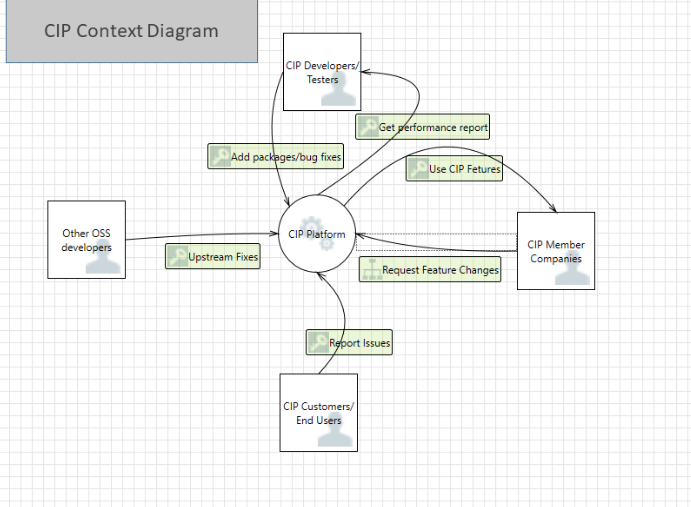
CIP Development Context Diagram
Threat ID |
Threats Identified |
Category |
Remarks |
Mitigation |
|---|---|---|---|---|
Threat_6.1.1_1 |
CIP Platform may be able to impersonate the context of Other OSS developers in order to gain additional privilege. |
Elevation of privileges |
A user gains increased capability or privilege by taking advantage of imp lementation bug |
Not applicable |
6.1.2 CIP Kernel Development
Following data flow diagram illustrates CIP Kernel development and how various external entities make changes in the CIP code.
Assumptions
Only CIP Kernel maintainers have merge privileges, all other developers can only send merger request, it’s up to CIP Kernel maintainer to accept or reject it.
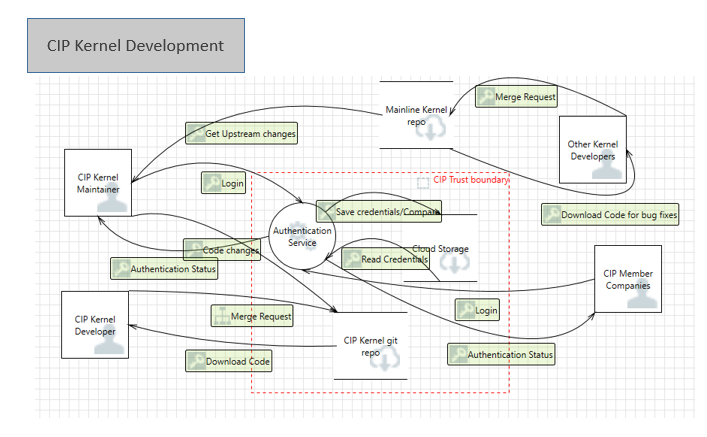
CIP Kernel Development DFD
Threat ID |
Threats Identified |
Category |
Remarks |
Mitigation |
|---|---|---|---|---|
Threat_6.1.2_5 |
Spoofing of Source Data Store Mainline Kernel repo |
Spoofing |
Mainline Kernel repo may be spoofed by an attacker and this may lead to incorrect data delivered to CIP Kernel Maintainer |
|
Threat_6.1.2_7 |
Aut hentication Service claims that it did not receive data from a source outside the trust boundary |
Repudiation |
Consider using logging or auditing to record the source, time, and summary of the received data. |
|
Threat_6.1.2_18 |
Weak Access Control for a Resource |
Information disclosure |
Review au thorization settings. |
|
Threat_6.1.2_41 |
Aut hentication Service May be Subject to Elevation of Privilege Using Remote Code Execution |
Elevation of privileges |
Each CIP member companies member should have right privileges |
|
Threat_6.1.2_42 |
Spoofing of the CIP Member Companies External Destination Entity |
Spoofing |
Use highest available login security mechanism such as 2F aut hentication |
|
Threat_6.1.2_49 |
Weak Access Control for a Resource |
Information disclosure |
Review au thorization settings of CIP Kernel git repo |
|
Threat_6.1.2_62 |
Spoofing of Destination Data Store CIP Kernel git repo |
Spoofing |
Consider using a standard aut hentication mechanism to identify the destination data store. |
|
Threat_6.1.2_63 |
The CIP Kernel git repo Data Store Could Be Corrupted |
Tempering |
Ensure the integrity of the data flow to the data store. |
|
Threat_6.1.2_67 |
Au thenticated Data Flow Compromised |
Tempering |
An attacker can read or modify data transmitted over an au thenticated data flow. send data encrypted |
|
Threat_6.1.2_68 |
Spoofing of Destination Data Store Mainline Kernel repo |
Spoofing |
Consider using a standard aut hentication mechanism to identify the destination data store. |
|
Threat_6.1.2_70 |
Weak Access Control for a Resource |
Information disclosure |
Review au thorization settings. |
6.1.3 CIP Core Development
Following diagram illustrates CIP Core development for isar and Deby. CIP Core has only meta-data and recipes as well as build tools. Actual package source code or binary packages are downloaded from Debian repos while creating CIP images.
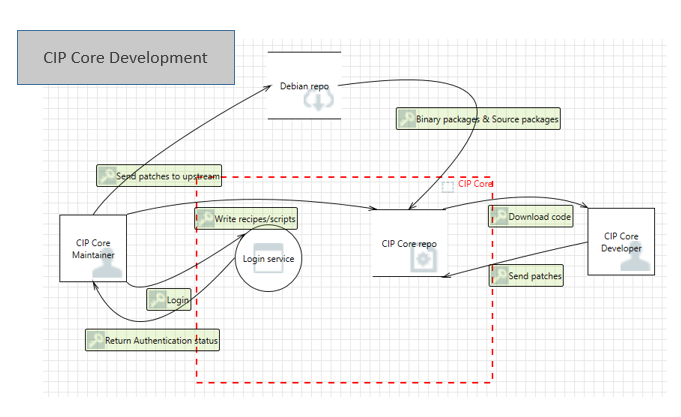
CIP Core Development DFD
Threat ID |
Threats Identified |
Category |
Remarks |
Mitigation |
|---|---|---|---|---|
Threat_6.1.3_79 |
Data Flow HTTPS Is Potentially Interrupted |
Denial of Service |
An external agent interrupts data flowing across a trust boundary in either di rection.Use aut hentication and send encrypted data |
|
Threat_6.1.3_84 |
Spoofing of the CIP Core Maintainer External Destination Entity |
Spoofing |
Consider using a standard aut hentication mechanism to identify the external entity. |
|
Threat_6.1.3_87 |
Spoofing of Destination Data Store CIP Core repo |
Spoofing |
Consider using a standard aut hentication mechanism to identify the destination data store. |
|
Threat_6.1.3_88 |
The CIP Core repo Data Store Could Be Corrupted |
Tempering |
Ensure the integrity of the data flow to the data store. |
|
Threat_6.1.3_92 |
Spoofing of Destination Data Store CIP Core repo |
Spoofing |
Consider using a standard aut hentication mechanism to identify the destination data store. |
|
Threat_6.1.3_97 |
Spoofing of Source Data Store CIP Core repo |
Spoofing |
Consider using a standard aut hentication mechanism to identify the source data store. |
|
Threat_6.1.3_98 |
External Entity CIP Core Developer Potentially Denies Receiving Data |
Repudiation |
Consider using logging or auditing to record the source, time, and summary of the received data. |
|
Threat_6.1.3_99 |
Weak Access Control for a Resource |
Information disclosure |
Review au thorization settings. |
6.1.5 CIP OS Image Creation
Following diagram illustrates data flow when CIP image is created. While creating CIP image CIP Kernel source is downloaded as well as Debian packages source or binaries. Once the image is created it is saved in external storage such as AWS.
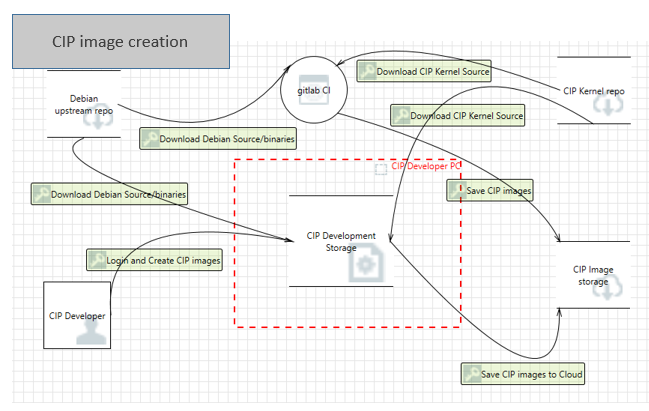
CIP Image Creation DFD
Threat ID |
Threats Identified |
Category |
Remarks |
|---|---|---|---|
Threat_6.1.5_102 |
Spoofing of Source Data Store Debian upstream repo |
Spoofing |
Consider using a standard authentication mechanism to identify the source data store. |
Threat_6.1.5_103 |
Spoofing of Destination Data Store CIP Development Storage |
Spoofing |
Consider using a standard authentication mechanism to identify the destination data store. |
Threat_6.1.5_107 |
Spoofing of Source Data Store CIP Kernel repo |
Spoofing |
Consider using a standard authentication mechanism to identify the source data store. |
Threat_6.1.5_112 |
Spoofing of Source Data Store CIP Development Storage |
Spoofing |
Consider using a standard authentication mechanism to identify the source data store. |
Threat_6.1.5_113 |
Spoofing of Destination Data Store CIP Image storage |
Spoofing |
Consider using a standard authentication mechanism to identify the destination data store |
Threat_6.1.5_114 |
Data Store Denies CIP Image storage Potentially Writing Data |
Repudiation |
Consider using logging or auditing to record the source, time, and summary of the received data. |
Threat_6.1.5_116 |
Data Store Inaccessible |
Denial of Service |
An external agent prevents access to a data store on the other side of the trust boundary. |
T hreat_6.1.5_122 |
Spoofing of Source Data Store CIP Kernel repo |
Spoofing |
Consider using a standard authentication mechanism to identify the source data store |
Threat_6.1.5_123 |
Weak Access Control for a Resource |
Information disclosure |
Review authorization settings |
Threat_6.1.5_126 |
Spoofing of Destination Data Store CIP Image storage |
Information disclosure |
Consider using a standard authentication mechanism to identify the destination data store. |
Threat_6.1.5_130 |
The CIP Development Storage Data Store Could Be Corrupted |
Tempering |
Ensure the integrity of the data flow to the data store. |
Threat_6.1.5_215 |
Potential Process Crash or Stop for gitlab CI |
Denial of Service |
CIP gitlab CI crashes, halts, stops or runs slowly; in all cases violating an availability metric. |
Threat_6.1.5_226 |
The CIP Image storage Data Store Could Be Corrupted |
Tempering |
Ensure the integrity of the data flow to the data store. |
Threat_6.1.5_227 |
Data Store Denies CIP Image storage Potentially Writing Data |
Repudiation |
Consider using logging or auditing to record the source, time, and summary of the received data. |
6.2 Process View
6.2.1 CIP as networking switch
Following diagram depicts a CIP use case when Networking Switch is developed using CIP platform.
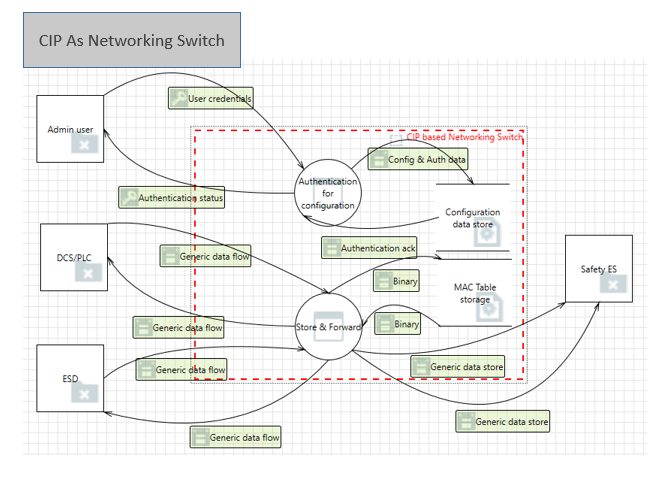
CIP As Networking Use Case DFD
Following threats table list all the threats identified using DFD.
Threat ID |
Threats Identified |
Category |
Remarks |
|---|---|---|---|
Threat_6.2.1_146 |
Potential Data Repudiation by Store & Forward |
Repudiation |
Consider using logging or auditing to record the source, time, and summary of the received data. |
Threat_6.2.1_148 |
Potential Process Crash or Stop for Store & Forward |
Denial of service |
Store & Forward crashes, halts, stops or runs slowly; in all cases violating an availability metric Needs Investigation. |
Threat_6.2.1_150 |
Elevation Using Impersonation |
Elevation using impersonation |
Store & Forward may be able to impersonate the context of DCS/PLC in order to gain additional privilege. |
Threat_6.2.1_151 |
Store & Forward May be Subject to Elevation of Privilege Using Remote Code Execution |
Elevation of privileges |
DCS/PLC may be able to remotely execute code for Store & Forward. |
Threat_6.2.1_152 |
Elevation by Changing the Execution Flow in Store & Forward |
Elevation of privileges |
An attacker may pass data into Store & Forward in order to change the flow of program execution within Store & Forward to the attacker’s choosing. |
Threat_6.2.1_155 |
Spoofing of the DCS/PLC External Destination Entity |
Spoofing |
Consider using a standard authentication mechanism to identify the external entity. |
Threat_6.2.1_156 |
External Entity DCS/PLC Potentially Denies Receiving Data |
Repudiation |
Consider using logging or auditing to record the source, time, and summary of the received data. |
Threat_6.2.1_163 |
Potential Process Crash or Stop for Store & Forward |
Denial of service |
Store & Forward crashes, halts, stops or runs slowly; in all cases violating an availability metric.Needs Investigation. |
Threat_6.2.1_164 |
Data Flow Binary Is Potentially Interrupted |
Denial of service |
An external agent interrupts data flowing across a trust boundary in either direction.Needs Investigation. |
Threat_6.2.1_166 |
Store & Forward May be Subject to Elevation of Privilege Using Remote Code Execution |
Elevation of privileges |
ESD may be able to remotely execute code for Store & Forward. |
Threat_6.2.1_173 |
Spoofing of the Safety ES External Destination Entity |
Spoofing |
Consider using a standard authentication mechanism to identify the external entity. |
Threat_6.2.1_176 |
Authenticated Data Flow Compromised |
Tempering |
An attacker can read or modify data transmitted over an authenticated dataflow. |
Threat_6.2.1_182 |
Weak Access Control for a Resource |
Information disclosure |
Review authorization settings. |
Threat_6.2.1_191 |
Authorization Bypass |
Information disclosure |
Ensure that your program is the only one that can access the data, and that all other subjects have to use your interface. |
Threat_6.2.1_195 |
Weak Credential Storage |
Information disclosure |
Credentials held at the server are often disclosed or tampered with and credentials stored on the client are often stolen. For server side, consider storing a salted hash of the credentials instead of storing the credentials themselves. If this is not possible due to business requirements, be sure to encrypt the credentials before storage, using an SDL-approved mechanism. For client side, if storing credentials is required, encrypt them and protect the data store in which they’re stored |
Threat_6.2.1_196 |
Potential Excessive Resource Consumption for Authentication for configuration or Configuration data store |
Denial of Service |
Resource consumption attacks can be hard to deal with, and there are times that it makes sense to let the OS do the job. Be careful that your resource requests don’t deadlock, and that they do timeout. |
Threat_6.2.1_234 |
Data Flow Authentication status Is Potentially Interrupted |
Denial of Service |
An external agent interrupts data flowing across a trust boundary in either direction. |
Threat_6.2.1_236 |
Potential Process Crash or Stop for Authentication for configuration |
Denial of Service |
Authentication for configuration crashes, halts, stops or runs slowly; in all cases violating an availability metric. |
Threat_6.2.1_238 |
Elevation Using Impersonation |
Elevation of privileges |
Authentication for configuration may be able to impersonate the context of Admin User in order to gain additional privilege. |
6.2.2 CIP as PLC
Following diagram depicts a CIP use case using PLC.
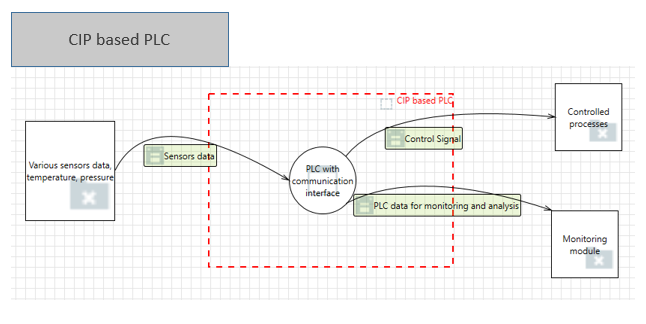
CIP based PLC
Threat ID |
Threats Identified |
Category |
Remarks |
|---|---|---|---|
Threat_6.2.2_197 |
Spoofing the PLC with communication interface Process |
Spoofing |
Consider using a standard authentication mechanism to identify the destination process. |
Threat_6.2.2_198 |
Spoofing the Various sensors data, temperature, pressure External Entity |
Spoofing |
Consider using a standard authentication mechanism to identify the external entity. |
Threat_6.2.2_200 |
Potential Data Repudiation by PLC with communication interface |
Repudiation |
Consider using logging or auditing to record the source, time, and summary of the received data. |
Threat_6.2.2_201 |
Data Flow Sniffing |
Information disclosure |
Data flowing across Sensors data may be sniffed by an attacker. Depending on what type of data an attacker can read, it may be used to attack other parts of the system or simply be a disclosure of information leading to compliance violations. Consider encrypting the data flow. |
Threat_6.2.2_202 |
Potential Process Crash or Stop for PLC with communication interface |
Denial of Service |
PLC with communication interface crashes, halts, stops or runs slowly; in all cases violating an availability metric. |
Threat_6.2.2_204 |
Elevation Using Impersonation |
Elevation of privileges |
PLC with communication interface may be able to impersonate the context of Various sensors data, temperature, pressure in order to gain additional privilege. |
Threat_6.2.2_208 |
Spoofing of the Controlled processes External Destination Entity |
Spoofing |
Consider using a standard authentication mechanism to identify the external entity. |
Threat_6.2.2_209 |
External Entity Controlled processes Potentially Denies Receiving Data |
Repudiation |
Consider using logging or auditing to record the source, time, and summary of the received data. |
7. Potential Threats To the System and Mitigation
This section will have consolidated list of threats identified from various use cases and data flow scenarios. Example of mitigation could be any of the following actions.
Add Debian packages to CIP
Provide Security Configurations
Provide Security Guidelines
Threat ID |
Use case / Scenario |
Impact |
Mitigation |
|---|---|---|---|
Threat_6.2.1_146 |
CIP based networking switch has store & forward process, it claims that it did not receive data from a source outside the trust boundary |
Repudiation |
CIP should address this issue by including logging or auditing to record the source, time, and summary of the received data |
Threat_6.2.1_148, Threat_6.2.1_163, Threat_6.2.1_164 |
CIP based networking switch has store & forward process, it crashes, stops or runs slowly |
Denial of service |
Needs Investigation. |
Threat_6.2.1_150 |
CIP based networking switch has store & forward process, it may be able to impersonate the context of DCS/PLC to gain additional privileges |
Elevation of using impresonation |
Authentication and authorization of all external entities |
Threat_6.2.1_151, Threat_6.2.1_152, Threat_6.2.1_166 |
Store & Forward process may be subject to Elevation of Privilege using Remote Code Execution |
Elevation of privileges |
Avoid using remote code execution |
Threat_6.2.1_155, Threat_6.2.1_173 |
Spoofing of external entities which communicate or send/receive data to CIP |
Spoofing |
CIP should include standard authentication mechanism for all external entities |
Threat_6.2.1_156 |
External entities communicating with CIP potentially denies receiving data |
Repudiation |
Same mitigation as for T hreat_6.2.1_146 |
Threat_6.2.1_176 |
Data flow between authenticated external entities tempered, e.g. An attacker can read or modify data transmitted over an authenticated dataflow |
Tempering |
CIP should include latest encryption capabilities and all data should be shared in encrypted form |
Threat_6.2.1_182 |
Weak Access Control for a Resource |
Authorization |
CIP should provide guidelines to end product owners to have role based authorization policies for all users |
Threat_6.2.1_191 |
When external entities can modify data without having privilege |
Authorization bypass |
CIP should provide guidelines all external entities use the interfaces exposed for data modifications |
Threat_6.2.1_195 |
When CIP has weak Credential Storage or credentials are stored without encryption |
Information disclosure |
CIP should keep all credentials as encrypted and same should be recommended to end users |
Threat_6.2.1_210 |
An attacker could execute code remotely if he got access to the system. |
Remote code execution |
CIP users should use whitelisting to ensure only known good processes can be executed. |
Threat_6.2.1_211 |
An attacker could manipulate the system time to enable another attack. |
System defense weakend |
CIP users should enable secure time updates in their systems. |
8. Validation of Threats and Mitigation
TBD
9. CIP Core Packages for mitigation
Threat ID |
Mitigation |
Required package |
|---|---|---|
Threat_6.2.1_146 Threat_6.2.1_156 |
CIP should address this issue by including logging or auditing to record the source, time, and summary of the received data |
|
Threat_6.2.1_148, Threat_6.2.1_163, Threat_6.2.1_164 |
Needs to discuss with members how to address this threat |
|
Threat_6.2.1_150, Threat_6.2.1_155, Threat_6.2.1_173 |
Authentication and authorization of all external entities |
|
Threat_6.2.1_151, Threat_6.2.1_152, Threat_6.2.1_166, Threat_6.2.1_182, Threat_6.2.1_191 |
Avoid using remote code execution |
|
Threat_6.2.1_176 |
CIP should include latest integrity verification capabilities and all data should be shared in encryped form |
|
Threat_6.2.1_191 |
CIP should provide guidelines all external entities use the interfaces exposed for data modifications |
|
Threat_6.2.1_195 |
CIP should keep all credentials as encrypted and same should be recommended to end users |
|
Threat_6.2.1_210 |
CIP users should use aide for whitelisting to ensure only known good processes can be executed. |
|
Threat_6.2.1_211 |
CIP users should use chrony to securely update their system time. |
|
10. CIP Kernel Threat Modeling
CIP Security WG needs to discuss with CIP Kernel WG how to approach Threat Modeling for CIP Kernel, some of the options could be. 1. Identify the risks for CIP Kernel 2. Identify important data flows which might be compromised 3. Identify other sources which may pose risk to CIP and mitigate
11. Updating CIP Threat Model
CIP Threat Model should be updated and revised based on following conditions.
When CIP Core adapts new version of Debian
New Packages or functionality added which may be exploited by internal or external entities
When CIP adapts new version of CIP Kernel
12. Further Guidelines for End Product owners
End products owners are advised to follow steps listed here to re-use existing CIP reference Threat Model.
Identify Security Requirements specific to the product
Identify business goals for the product
List down critical data flow for business scenarios
Use one the Threat Modeling methods for additional use cases
13. Acronyms
Acronym |
Detail |
|---|---|
CIP |
Civil Infrastructure Platform |
CVE |
Common Vulnerabilities and Exposures |
CVSS |
Common Vulnerability Scoring System |
PLC |
Programmable Logic Controller |
DCS |
Distributed Control System |
STRIDE |
Spoofing, Tampering, Repudiation, Information Disclosure |
14. CIP Core CVE scanner
CIP Core uses CVSS threat modeling methodologies and uses Debian based wrapper to automatically scan upstream repos and include the fixes.
The CVE scanner tool is available at
15. CIP Kernel CVE scanner
CIP Kernel uses CVE scanner to get latest CVE fixes and applies to CIP Kernel. The repo is available at CIP Kernel CVE Scanner
16. References
Reference name |
Link |
|---|---|
Microsoft Threat Modeling Tool |
https://www.microsoft.com/en-in/download/details.aspx?id=49168 |
17. Pending Work and known issues
Add setting for text wrapping, currently whole page is occupied by text
Split this document and keep CIP Kernel, CIP Core threat modeling in a separate document based on other members inputs
Discuss with other CIP WG members to identify real business CIP use case scenarios and create Threat Models for them
Further investigation to address embedded system specific exploits such as listed in https://www.apriorit.com/dev-blog/690-embedded-systems-attacks